The Business Case for Outsourcing Workplace Services
Spotlight on Technology
An ROI Framework for Operations Leaders
Outsourcing workplace services functions rarely live or die on intuition. It lives or dies on the numbers a CFO can defend in a budget meeting. “Our team seems overwhelmed” isn’t a business case. A structured, defensible ROI model is.
This briefing gives operations leaders, facility directors, and finance partners a repeatable framework for building that case that covers direct cost reduction, headcount and overhead savings, technology access value, risk transfer, and service-level improvement. Use it as a template for your own internal analysis, anchored against benchmarks IST has seen across facilities and Workplace Services engagements.
Why the Gut-Feel Pitch Falls Apart
Most outsourcing conversations start the same way: mail is backing up, receptionist coverage is inconsistent, vendors aren’t held accountable, and nobody has a clean picture of what any of it actually costs today. That’s a real problem — but it’s not a business case. Finance needs a model that isolates cost drivers, quantifies the delta, and shows where the savings actually come from. Without that, “outsource workplace services” competes for budget against initiatives that already have a spreadsheet behind them.
The good news: the ROI math for Workplace Services outsourcing is well understood. It breaks down into five levers.
Five Levers That Build the Business Case
1. Direct Cost Reduction
Start with the line items finance already tracks: staffing, supplies, equipment leases, and vendor contracts across mail, print, hospitality, and facilities. Outsourced providers consolidate purchasing power and staffing models across their full client base, which typically compresses these direct costs well below what a single organization pays managing them independently.
2. Headcount & Overhead Savings
Beyond direct spend, in-house teams carry HR overhead, such as recruiting, training, benefits administration, and management layers, that don’t show up on a services invoice but absolutely show up on a P&L. Outsourcing shifts that overhead to the provider, freeing internal management bandwidth to focus on core business priorities instead of shift schedules and vendor disputes.
3. Technology Access Value
Most internal teams cannot justify building their own management software. An outsourced partner brings a platform, like IST Suite, in our case, as part of the engagement: dashboards for jobs, service calls, and work orders; barcode tracking; automated monthly reporting; and a 24/7 support portal. That’s enterprise-grade visibility at no incremental technology spend, and it’s a real line item in the ROI model even though no invoice calls it out separately.
4. Risk Transfer
Vendor vetting, safety compliance, insurance verification, and regulatory tracking are ongoing liabilities when managed internally. Shifting responsibility to a partner with established vendor governance in financial health checks, SLA audits, compliance tracking, reduces the organization’s exposure, and the hidden cost of managing it. Risk transfer rarely gets its own line in a spreadsheet, but finance leaders should quantify it: what would one compliance failure or vendor dispute cost?
5. Service-Level Improvement
The final lever isn’t a cost reduction, but a value creation. SLA-backed service means measurable response times, tracked resolution rates, and accountability that in-house teams, stretched across too many priorities, often can’t sustain. Better service isn’t soft; it shows up as fewer escalations, faster turnarounds, and a workplace experience that doesn’t distract leadership from the business they’re running.
The Framework in Action
Here’s how the five levers typically map onto a real internal business case:
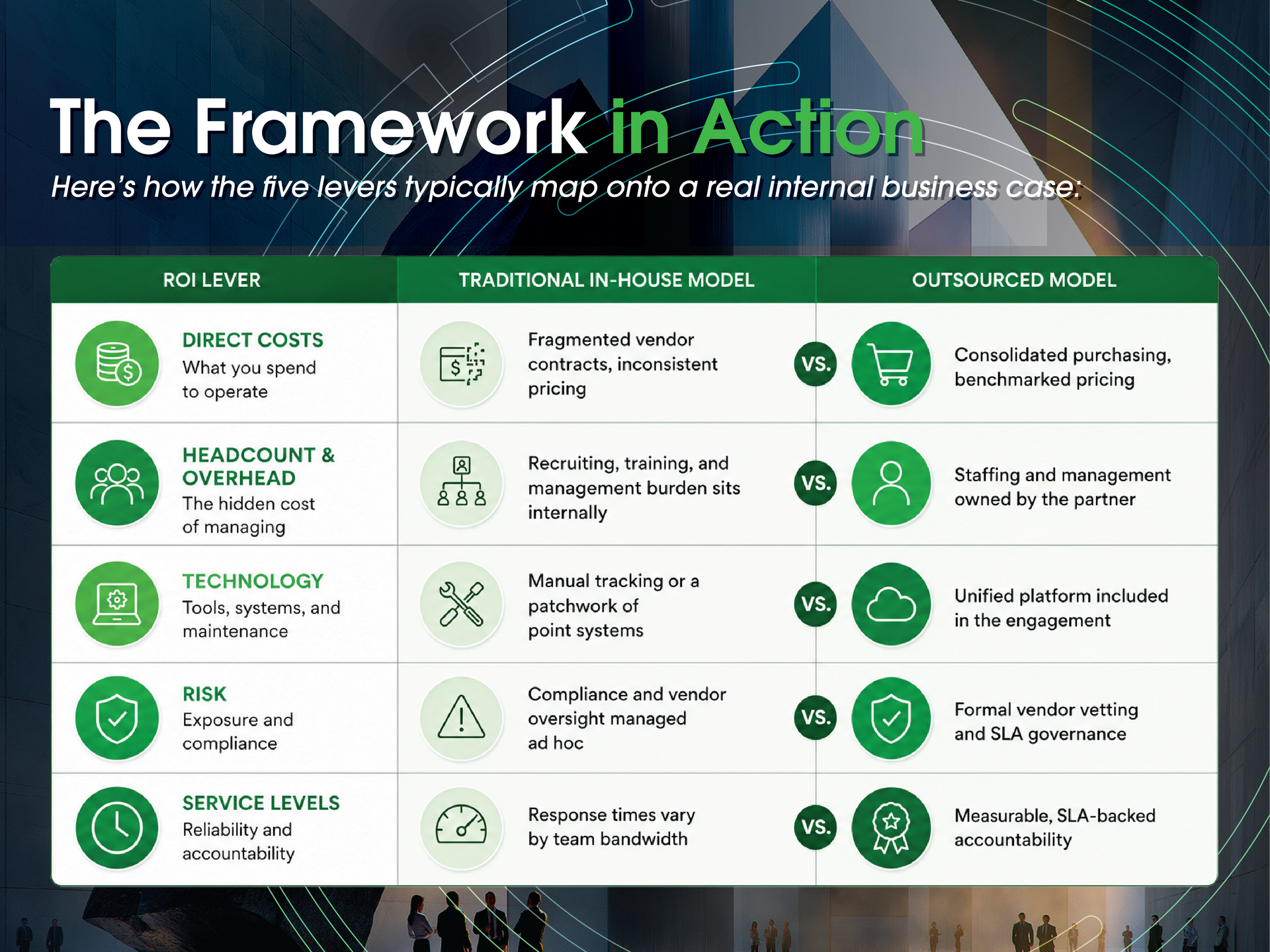
Multi-location organizations tend to see the framework compound: consolidating facilities data across sites onto a single platform doesn’t just save on software, it surfaces spending patterns and service gaps that were previously invisible because every location managed things differently.
Building Your Own Business Case
To adapt this framework internally:
- Baseline today’s true cost. Include staffing, overhead, vendor spend, and the management time it takes to keep everything running, not just the visible invoices.
- Quantify each lever separately. Direct cost reduction and risk transfer live in different parts of the P&L; don’t let one obscure the other.
- Anchor to benchmarks, not estimates. Ask a prospective partner for real client data on cost reduction, response times, and platform adoption rather than industry averages.
- Model the technology value explicitly. A platform like IST Suite has a real replacement cost; include it, even though it won’t appear as its own invoice line.
One Partner. Every Line Item Covered.
The strongest business case isn’t the one with the biggest number, but the one finance can trace, lever by lever, back to the operation. When outsourcing workplace services is framed as a financial model instead of a relief valve, it stops competing with other budget priorities on vibes and starts competing on math.
IST has built this ROI framework working with law firms, universities, financial institutions, and Fortune 1000 organizations managing multi-location workplace and facilities operations. If you’re building an internal business case, we can help you benchmark it.
Have a conversation with one of our experts who can customize a workplace experience to suit your needs.